.png)


From Polarization to Dialogue: Nonviolent Communication

Updated: Apr 23
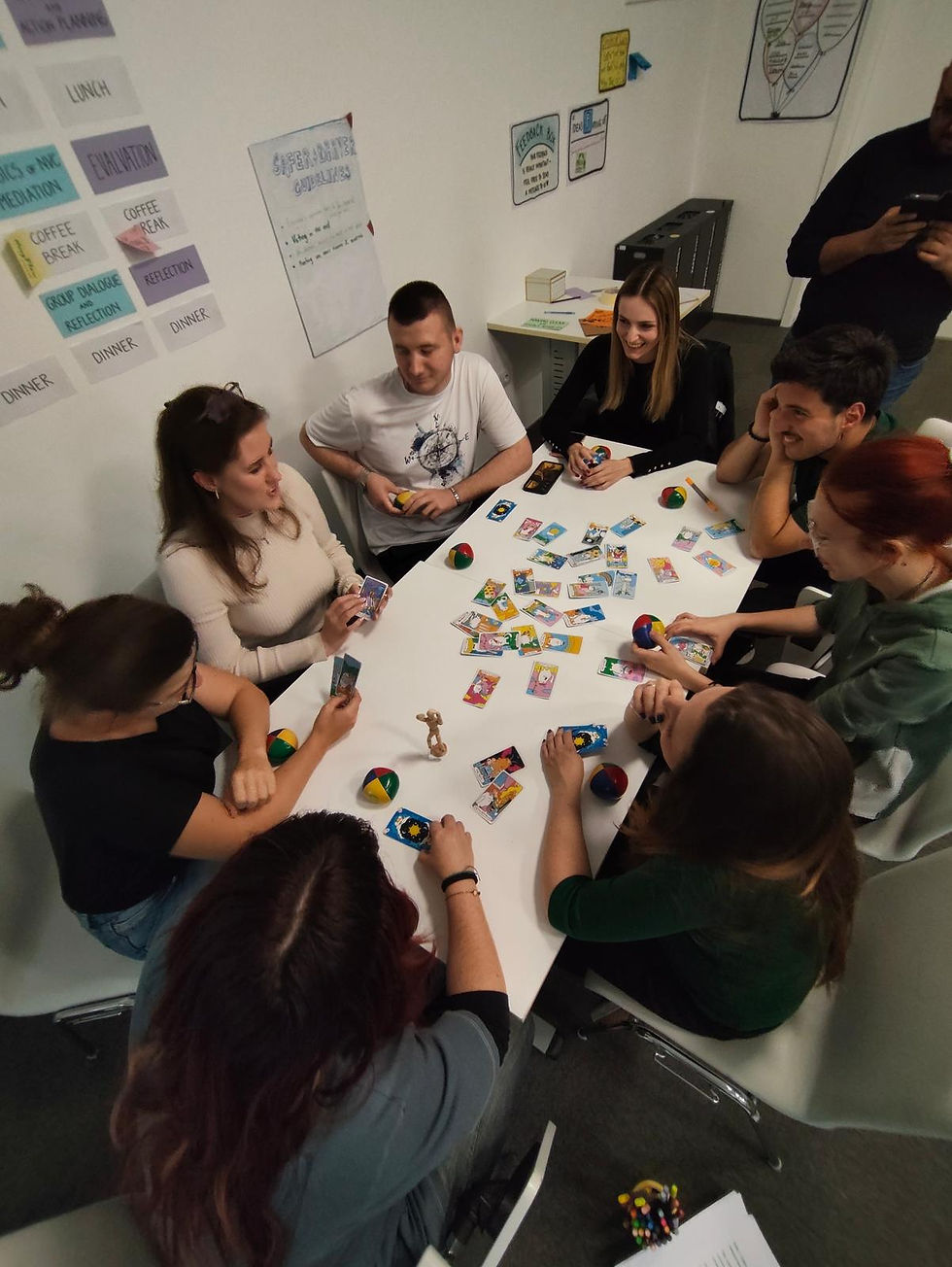
Between the 11th and 15th of April, I found myself already for the second time in Brežice, Slovenia, together with around 25 people from different countries. What made this group special wasn’t just where we came from. We were all, in one way or another, working with people: educators, psychologists, youth workers... People who are used to supporting others. And yet, for a few days, we had to turn that attention… inward.

The first day felt familiar: names, games, energy check-ins. But very quickly, something shifted.
Instead of just learning how to communicate, we started asking ourselves uncomfortable questions:
What actually triggers me?
What do I do when I feel misunderstood?
Do I even understand my own needs?
We explored the idea that communication is like an iceberg. What we see, words, reactions, behaviour, is only the surface. Underneath, there are feelings, needs, values, and longings.

The part we think we know: empathy. We often say empathy is important. But practicing it, really practicing it, is something else. During the training, empathy meant:
being fully present,
listening beyond words,
staying curious instead of reactive.
And maybe the hardest part: not jumping in with advice. As people working in youth work or education, we’re used to helping. But here, we had to learn how to hold space instead.

We worked with the 4 steps of Non-Violent Communication:
Observations (without judgment)
Feelings
Needs
Requests
At first, it felt structured. But then it became something deeper. Because instead of blaming the other person, you start taking responsibility for your own experience. And suddenly, communication becomes less about defending… and more about connecting.

One of the strongest takeaways for me was this: Conflict is not the problem. Avoiding it, escaping it, or attacking through it, that’s where things break.
We explored four ways we usually react: fight, flight, freeze, curiosity. And only one of them actually creates dialogue. Curiosity. Not easy. But powerful.

What I’m taking with me? I didn’t leave Brežice with just new methods for youth work. I left with awareness.
How often do I truly listen?
How often do I react instead of understand?
How often do I clearly express what I need?
Non-violent communication is not just a tool. It’s a practice, a continuous one. We came to this training as professionals. But we left as humans who understood a bit more, about ourselves and about others. Because dialogue is not about being right. It’s about being real.


Text: Aleksandra Galkina


Comments